
Biosystems Engineering, BS
The Bachelor of Science in Biosystems Engineering integrates principles of all areas of engineering to produce well-rounded engineers in agriculture and natural resource systems. With an emphasis on engineering applications to complex biological systems, this ABET-accredited program launches students into careers in any engineering sector.
Program Overview
Biosystems engineers work with natural systems and integrate knowledge of engineering, mathematics, biology, chemistry, and physics to conserve natural resources, protect the environment, and efficiently produce and process safe, plentiful, high-quality food and fiber. Biosystems engineering students are known for their unique ability to identify potential problems before they start.
Students in this degree program take specialized biosystems engineering classes in biothermodynamics, biochemistry, mechanical systems, hydrology, bioprocessing, instrument and controls, and engineering design.
Biosystems engineering students participate in professional development opportunities through organizations like the American Society of Agricultural and Biological Engineers.
Concentrations
There are five biosystems engineering concentrations: bioprocess and food systems, ecological systems, integrated systems, mechanical and mechatronic systems, and pre-professional.
Why study Biosystems Engineering?
Integrative Research
Many unique research options are available across a variety of engineering disciplines through the Department of Biosystems Engineering and Soil Science. Research areas include: soil conservation and health, hydrology and water management, waste management, bioprocessing and biomass conversion, power and machinery, instrumentation and sensors, and control systems.
Senior Design Projects
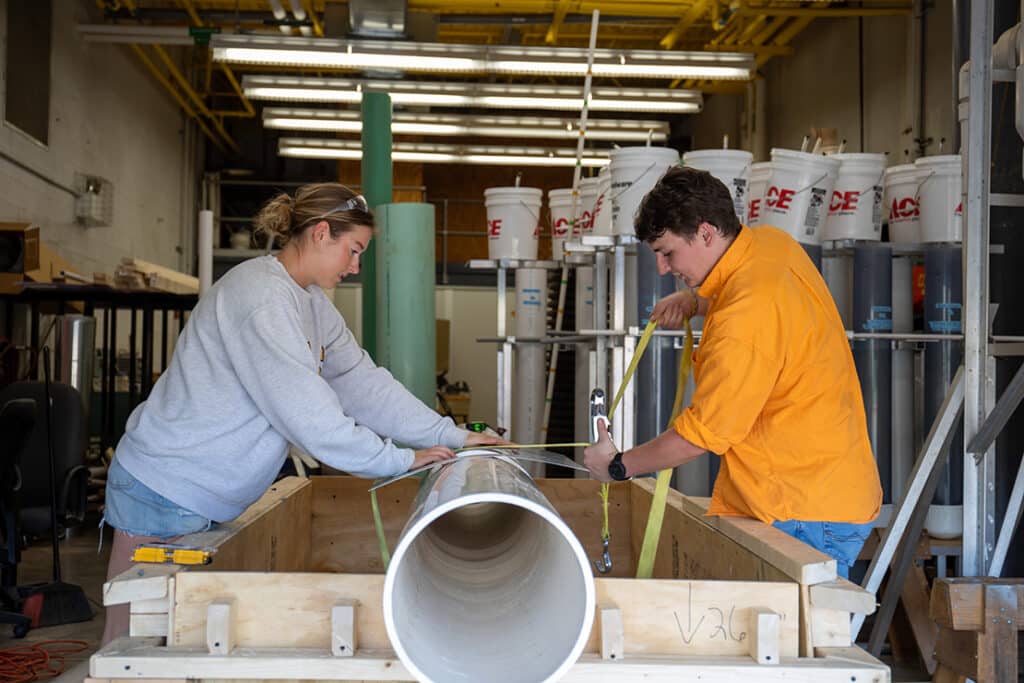
Biosystems engineering students complete a design project during their senior year. In this two-semester project, students first assess a real-world problem during the fall semester. By the spring semester, the design is completed and a prototype is built and tested.
Five-Year BS/MS
For qualified students, biosystems engineering also offers a five-year bachelor’s and master’s accelerated degree program, combining a bachelor’s degree in biosystems engineering with a thesis-based master’s degree.
What can you do with a degree in Biosystems Engineering?
Biosystems engineering is a diverse pathway in the world of engineering. From electrical to environmental, mechanical, and more, students gain experience in several areas of engineering to create a diversified skill set. Graduates have pursued employment in all engineering sectors, holding titles like agricultural engineer, water resources engineer, project engineer, and technical solutions engineer.
Featured Courses
BSE 224 – Introduction to Ecological Engineering
Comprehensive introduction to ecological engineering and design. Concepts include sustainability, wetlands, ecosystem services, nutrient cycling, watershed management, and nature-based solutions.
BSE 231 – Biochemistry for Engineers
Fundamentals of biochemistry presented from an engineering point of view and applied to solve engineering-related problems. Topics to be covered include fundamental organic chemistry of amino acids, carbohydrates, lipids and other important biochemicals; the role and control of pH in biological solutions; fundamental biochemistry of proteins and enzymes; introduction to bioenergetics and metabolic pathways, and the replication, transcription, and translation of DNA.
BSE 351 – Basic Electrical and Electronic Principles
Electrical and electronic principles; circuit components; basic laws and theorems in electrical circuits; d.c. and a.c. circuit analysis; electromagnetism; transformers, three-phase circuits, etc. Includes in-class experiments.
BSE 400 – Design Project I
With BSE 402*, this course comprises the biosystems engineering two-semester project sequence, in which student teams must tackle a stated problem, designing, building, and testing a prototype to determine success at meeting client performance criteria. Includes development of a major design proposal, including engineering analyses, extensive documentation, and a culminating group presentation.
BSE 451 – Electronic Systems
Basic electronics with biological applications. Analog and digital electronics; sensing and controlling physical and environmental parameters; sensor selection and interfacing; signal conditioning; process control. Includes laboratory experiments and design projects.
BSE 475 – Applied Mechatronic and Robotic Systems
Design of electromechanical solutions for automation. Integration of sensors, actuators, and microcontrollers as a system and its validation. Design and development of an automated platform, embedded system, and automated toolbox. Unmanned ground systems. Engineering team project.
Biosystems engineering’s unique introductory classes have introduced me to many industry professionals, taught me the fundamentals of engineering ethics, and have given me the opportunity to work side-by-side with seniors on their final projects. These seniors became my mentors, and I gained a better understanding of what is expected as I progress through biosystems engineering.”
Emily ElliS, 2026
Biosystems Engineering

Admissions and Aid
Learn more about admissions and aid by visiting the links below.